Excursion to Zambia
Victoria Falls, Unexpected Helicopters, and the Many Faces of Council Tax
By Peter Rau
We had always wanted to see the mighty Victoria Falls. We expected to be impressed. We did not expect quite everything else that came with it.In early spring 2010, we set course for the Sesheke border post, deliberately avoiding the Kazungula pont where one spends quality time jockeying for position between enormous trucks in a queue that operates on its own philosophical understanding of time.
The Border: A Multi-Building Administrative Adventure
The Namibian side went smoothly. Then we stopped at the Zambian side, and before the engine had fully settled, we were surrounded by runners and money changers materialising from every direction with the speed and coordination of a well-rehearsed flash mob.
We kept our cool. We pretended to be seasoned border crossers. This was not entirely convincing, but we committed to the performance.
The new immigration building was still under construction, so we were redirected to an older building that was making a strong case for demolition through structural argument alone. We paid for our first document and proceeded to the next small office. Then another. A friendly officer, clearly recognising the specific expression of wide-eyed hares staring into oncoming headlights, took pity on us and provided a guided tour of the bureaucratic landscape: go here, then there, then there, and when you have everything, come back to me.
We followed his instructions faithfully from building to building, office to office, until our final stop — a dilapidated caravan with a hole in the floor of considerable ambition.
Zambia, we noted with interest, was entirely relaxed about which currency you paid in — South African rand, Namibian dollars, US dollars, all welcome. You simply needed to be quick with the mental arithmetic across multiple exchange rates simultaneously, which is its own particular sport.
Documents collected: immigration, customs, road tax, carbon tax, third party insurance, and Sesheke council tax. We returned to our friendly officer, who checked everything, stapled the stack together with quiet satisfaction, and advised us that whenever a policeman stopped us, we should simply present the full collection. We thanked him warmly. He deserved it.
I believe they now have a brand spanking new building.
Livingstone: Where Wildlife Roams the Streets
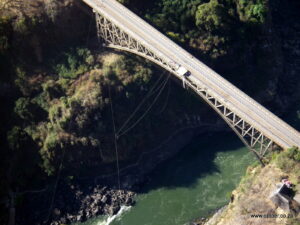
We crossed the mighty Zambezi on a beautiful bridge and followed the road to Livingstone — a genuinely wonderful town where donkeys, warthogs, and elephants treat the streets as a shared resource, which is either chaotic or charming depending on your outlook. We found it charming.
We stopped at the Victoria Falls Waterfront for lunch and a cold Mozi — the local Zambian beer, which we recommend — and promptly ran into Izak Smit, a mutual friend and helicopter pilot who flies tourists over the Falls.
We chatted. Mostly aviation. Then Izak excused himself and disappeared into the interior of the building.
He returned with the news that we needed to finish our lunch and our beers quickly, because he had arranged a helicopter flip over Victoria Falls for us.
We finished our lunch and beers at a pace that would have concerned our mothers.
Captain Benson and the Gorge
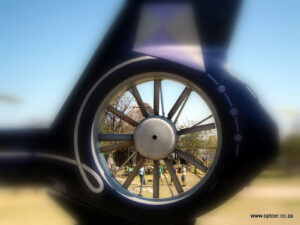
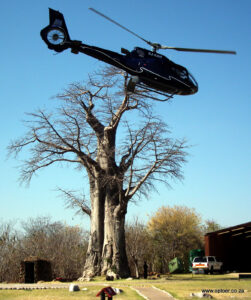
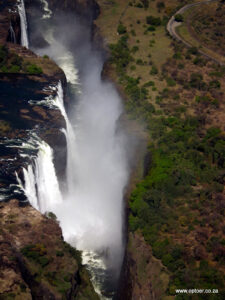
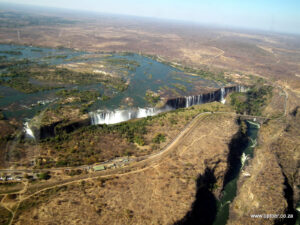
At Baobab Ridge, we met our pilot, Bruce Benson, completed the safety briefing and paperwork, and climbed into the back of a very impressive helicopter. We lifted off toward the Falls, and then — without much warning — dropped down into the gorge, flying low-level along the river all the way to the 26th Rapids.
At which point Captain Benson pitched the nose sharply skyward, climbed hard out of the gorge, executed a steep turn, and dove straight back in.
WHEEE is, I believe, the technically correct term for what followed.
We climbed high above the Falls for the full view — the spray, the scale, the sheer magnificent violence of all that water — and then returned to earth as different people than we had been an hour earlier.
Thank you, Captain Benson. Truly.
Crackers in the Night
We asked about camping for the night. Izak dismissed the question entirely and insisted we stay at his place, which was situated next to the Gwembe Castle Crocodile Farm — a sentence that would give most people pause, but by this point we were rolling with things.The sun was setting.
Izak jumped in his 4x4 to fetch meat for a braai and Mozis for general purposes, leaving us alone at a stranger's house in a foreign country, which felt perfectly natural by now.
Then: branches breaking. Gunshots. Explosions.
We stood very still and considered our options.Izak returned, took one look at us, and said to relax. It was just the locals throwing crackers and banging pots to drive elephants away from their small farmlands.
This continued throughout the night — the distant crack and boom of elephant deterrence drifting across the darkness like a very low-budget fireworks display.
Izak mentioned, almost as an aside, that some mornings he cannot get out of his gate because elephants are blocking it. This seemed to be simply a feature of life in the area rather than a concern.
The Many Councils of the Zambezi
The drive back to Sesheke introduced us to an impressive variety of revenue collection points.
A makeshift gate on the road: K20,000 for Kazungula Council Tax. A stop further along: more council tax. Then, on a branch placed across a sandy road: a young man who wanted 100 — in any denomination of your choosing, US dollars, Pula, Namibian dollars, South African rand, entirely up to you. We gave him R100, thanked him, and continued.
One begins to sense that Zambia has an entrepreneurial relationship with the concept of council tax.
Kabula Lodge: An Oasis After the Corrugations
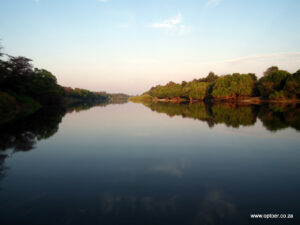
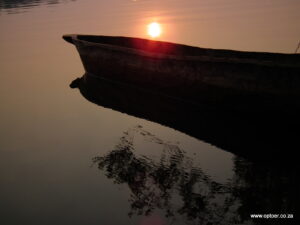
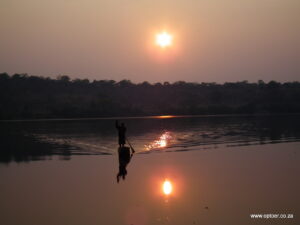
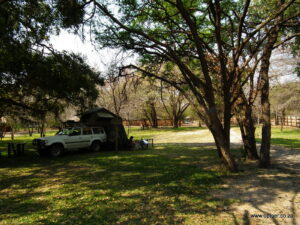
Following a tip from Piet at Kabula Lodge, we turned off down a winding two-spoor track through the bush — twisting, turning, crossing small plains busy with cattle — until, just as we were beginning to genuinely wonder how much further, we heard sprinklers and rounded a corner to find green grass.
Green grass. After all that dust and corrugation, the effect was almost hallucinatory.
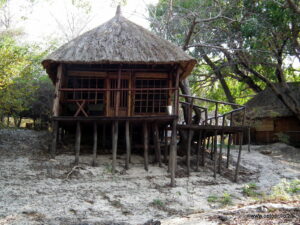
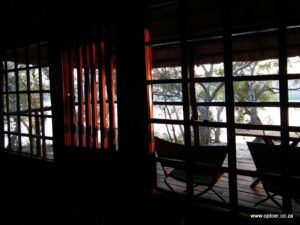
We booked a chalet on the river. That evening we had a braai and a long, excellent kuier with Piet and his wife Leonie.
The kind of evening that makes you grateful for spontaneous detours
Bakri and the Pink Sandals
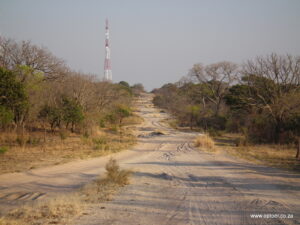
Early the next morning, a palace revolution of vervet monkeys erupted in the trees beside and on top of our chalet. Teeth brushed, faces washed, we drove further up the river — "driving" being a generous description of what was essentially a prolonged negotiation with the road.
We turned off to enter Ngoya Falls Park, paying US$15 to enter, collected by Nado the gatekeeper, who was also a part-time preacher and was in the middle of working on his sermon when we arrived. We drove down to the campsite.Two campsites.
We met Bakri — a long, thin man in pink sandals who would lead us to the falls.
We assumed the falls were nearby. We did not bring water. We did not bring hats.
The falls were not nearby.
Bakri set off at a steady pace in his pink sandals, entirely unbothered by the heat, which was — and I want to be precise here — cat-stutteringly, comprehensively, oppressively hot. I followed him. My wife followed me. Bakri's heels, I noticed as I trudged behind him, were cracked so deeply they resembled miniature versions of the very gorges we had flown over the previous day.
Bakri's conversational style was economical. His primary response to most questions was: "Eh, yes sir."
Me: "Bakri, how high does the river come when it floods?"
Bakri: "Eh, yes sir."
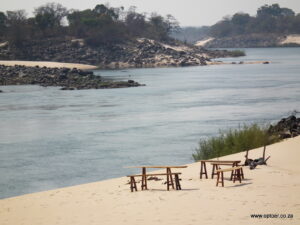
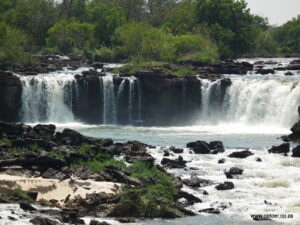
We reached the Sioma Falls. They were beautiful. It was too hot to take good photographs and we suffered back to the car.
Did I mention it was hot?

The Insect Motorway
Back at Kabula Lodge, we pitched the tent in the shade on the green grass and waited out the afternoon heat with cold beverages, which was the only sensible plan available.
While sitting there, we gradually became aware that we had set up camp directly on what appeared to be a major insect thoroughfare. High-revving F1 types screamed past at speed. Heavy freighters lumbered by, engines working hard. Some came through sounding as though they had significant mechanical issues, sputtering and misfiring. The motocross contingent launched themselves over bumps, crashed somewhere in the vegetation, picked themselves up, and crashed again further along.
We watched them for quite some time. There was really nothing else to do and it was, genuinely, more entertaining than it sounds.
The Corolla and the Tree Garage
We packed up, settled our accounts, and headed back toward Katima Mulilo. About 40 kilometres short of town, we came across a Toyota Corolla parked on the verge, bonnet up, several men peering into the engine bay with the focused concern of people who have exhausted their ideas.
What was wrong? They thought it was the gearbox.
I offered a tow. Yes please — to Sesheke, if possible. He settled his passengers on the roadside with literally a bucket half full of water — this apparently being the agreed arrangement — and we attached the Corolla and set off.
The road's centre was in places somewhat elevated, and the Corolla, being low-slung and now unpowered, was pressed into involuntary road-smoothing duties on the higher sections. Every so often I'd extend my hand out the window with a thumbs up. Somewhere behind me, through the dust, a hand would appear with a thumb up in return. All good. We continued.
Crossing the bridge into Sesheke, there is a large tree on the right. Underneath it: a collection of broken-down vehicles in various states of mechanical distress. This, we understood immediately, was the garage. We deposited the Corolla under the tree, said our goodbyes and good lucks, and headed for the border back into Namibia.
Africa, as ever, had delivered considerably more than advertised.
Happy travelling. — Peter Rau