Encounters of the Wild Kind
Africa: Where Everything is Trying to Meet You (Whether You Like It or Not)
By Peter Rau
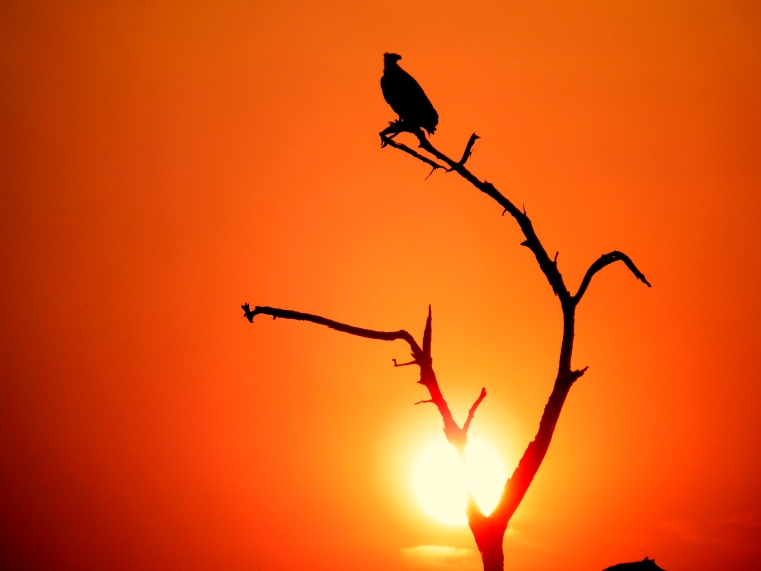
Africa: Beautiful, Unhurried, and Occasionally Lethal
Hours of boredom, seconds of excitement
When you come to Africa, you will find beauty in the most unexpected places — stunning landscapes, extraordinary wildlife, and people who will make you feel genuinely welcome. There's a saying that the Swiss invented the watch, but Africa owns the time. So leave your schedule at the border, pack your patience, your small talk, and your friendliness, and prepare to slow right down. There is also another saying that Africa wants to kill you. And if you think about it carefully, it's not entirely wrong. The water might have bilharzia. Some rivers look perfectly drinkable — the locals drink from them — but if you try it, your stomach will file a formal complaint within hours. Mosquitoes carry malaria. Anti-malaria pills won't prevent it entirely, but they'll soften the blow considerably. Cover up at dawn and dusk. Then there are the carnivores — wild dogs, cheetahs, leopards, hyenas, lions — all of whom regard you with varying degrees of culinary interest. Elephants, rhino, and buffalo can do serious damage to both you and your vehicle. Crocodiles lurk. Hippos, despite looking like large grumpy sofas, are currently the top killers of humans among African wildlife — ranking just above the mosquito, which is frankly embarrassing for everyone involved. In winter, it can drop to minus 11 Celsius in the Kalahari. In summer, thunderstorms arrive with golf-ball hail, flash floods, and the occasional tornado. Also drought. Also dust storms. Also 50-plus degree heat.Africa is, in short, spectacular. Please do come along.
Insects: The Smallest, Most Persistent Residents
On one of our first Kalahari arrivals, we were greeted that night not by lions, not by hyenas, but by moths. Not small, polite moths. Enormous moths, hunting desperately for any moisture they could find — your sweat, your water, your gin and tonic. Especially your gin and tonic. We spent the evening covering everything we owned while the moths threw themselves at us with extraordinary commitment.
At Kubu Island on a scorching October day, we were besieged by flies from sunrise to sunset. It was so hot that we were drinking gin and tonic like water and sweating it out just as quickly. We retreated into the tent to escape the flies, couldn't bear the heat, came back outside to escape the heat, couldn't bear the flies. We went back and forth like this for most of the day. I did briefly wonder whether all that wing-flapping was making it marginally cooler. Probably not.
In the Moremi, we were once invaded by millions of tiny green flying insects that forced themselves into every possible gap, crack, zip, and crevice of our camp. The coup de grâce: if you killed one, it stank. Breaking camp took an age as we extracted stowaways from every corner. When we reported this at the gate, the official smiled serenely and said: "It is their time, sir." Which was both perfectly correct and completely unhelpful.
The honeybees at Sunday Pan deserve a special mention. One day, we arrived just after 2pm on a scorching day and were immediately surrounded by bees looking for water. Nothing deterred them — not a plate of cold drink placed strategically at the edge of the campsite, not waving, not politely asking them to leave. We were booked for three days and these bees were everywhere. Eventually we discovered their nest was in the long drop. Don't think about that too long.
In a moment of sleep-deprived genius, we covered the toilet with a plastic bag before sunrise the next morning. The following two days were magnificent. We did, to our credit, report the situation to the park officials on departure. I still wonder how that honey tasted.
Camping next to the Zambezi in Zambia, with nothing to do but sit in the heat and watch the world drift by, we found ourselves rating the insects by sound. There were the F1 racers — tiny, high-pitched, gone before you registered them. The lumbering juggernauts with their heavy radial engines, two cylinders clearly misfiring. The Star Wars pod racers. And then the stop-starters, who'd fly in, look around with evident suspicion, and leave. We even gave them names. This is what the African bush does to you and I have no regrets.
On the subject of ticks: they are sneaky, silent, and they make for places on your body that you cannot easily see. Have someone check you over regularly. If a tick hasn't yet bitten in, flick it off. If it has, smother it with Vaseline, Vicks, or grease — it'll release when it can't breathe. Do not rip it off bodily, or the head stays behind in your skin and you have a new, worse problem.
Sand tampans in the Kalahari are another delight entirely. They live underground in tree shade, waiting patiently for something warm to shelter from the sun above them. The moment they detect carbon dioxide, they erupt from the sand and get to work. If they bite humans, the results include skin inflammation, fever, and lymph inflammation. They are very small and they do not care about your feelings.
Scorpions walk around with what looks like a rifle over their shoulder, which is fair warning. We've found them regularly when breaking camp — they love to hide under groundsheets. The large ones, like the specimen we found at Spitskop in Namibia, give you a proper fright. The birds in that area, however, have clearly worked out that humans breaking camp is an early warning system for scorpion availability. They gather and wait. We felt vaguely used.
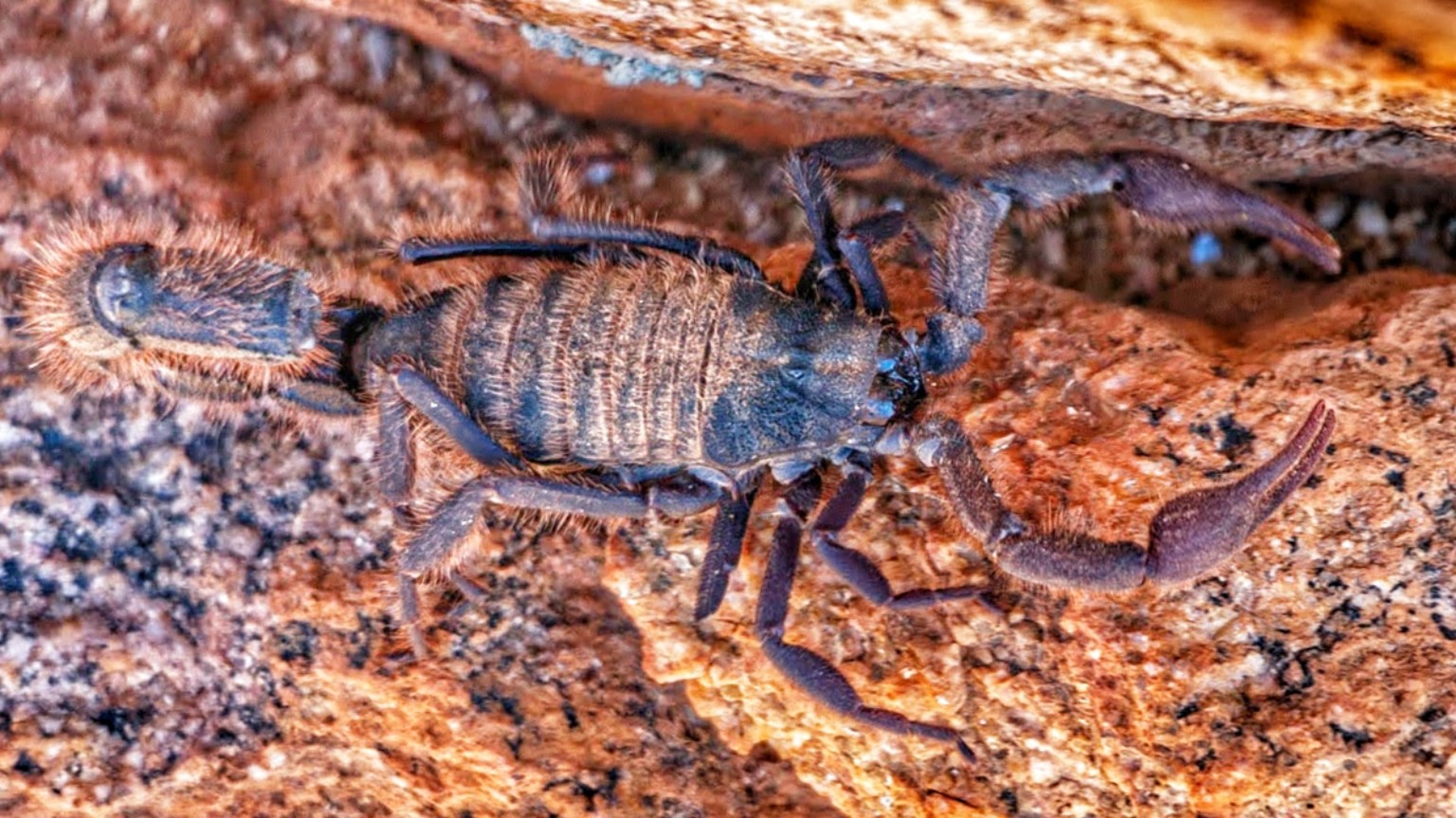
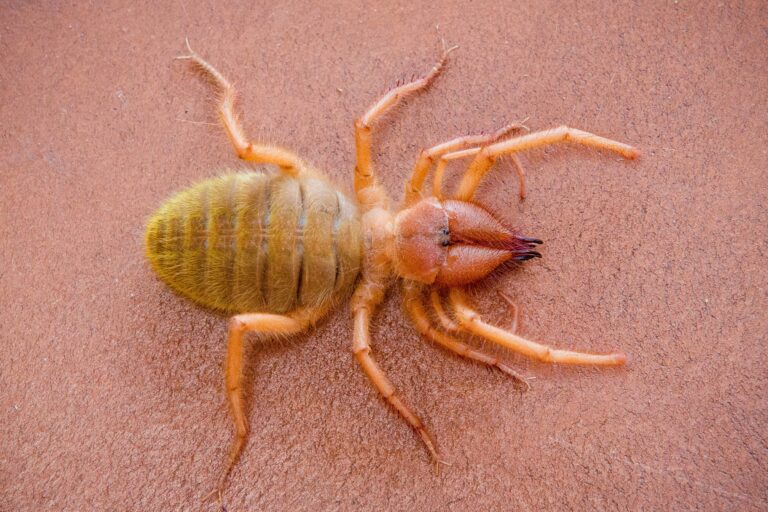
Spiders, they range from small and annoying to the size of a dinner plate and alarming. They also travel. A Roman spider hitchhiked in our tent from the Cederberg mountains all the way to the Karoo — three weeks later — before casually introducing itself. I put it in a container and released it into the nearest bush to hunt. Or to be hunted. Either way, not my tent anymore.
In the Northern Cape one December, every night our flashlight revealed a crisscrossing motorway of huge red Roman spiders and yellow-tailed scorpions across the campground. Do not walk barefoot at night. I cannot stress this enough.
One night in that same heat, I felt something light brush my ankle and thought nothing of it. Moments later, my wife made sounds that I can only describe as not of this world — a huge red Roman spider was running up her leg. Lights on, bat in hand, we searched everywhere. Then she screamed that it was behind me. I cleared a double bed in a single leap. I am not exaggerating the size when I say it was bigger than my palm.
We don't talk about it much anymore.
Snakes: Calmer Than You Will Be
Most snakes want nothing to do with you and will do their best to leave before you notice them. Some, however, will bite if threatened — and some of those bites are extremely serious.
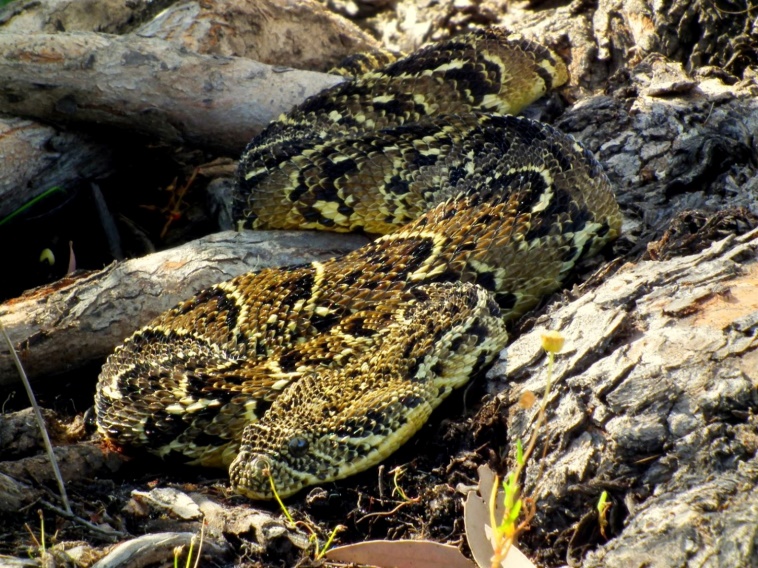
Many years ago, a tourist in our group was bitten by a puffadder without realising it. He thought the underbrush had scratched him. The next day he felt ill; we assumed it was his diabetes. It was only a week later that doctors diagnosed the puffadder bite. The silver lining? Because he didn't know, he stayed calm — and staying calm kept his blood pressure down, slowing the venom's journey to his vital organs. He survived. The lesson: if bitten, try to remain calm. Yes, I know. Try anyway.
Also — identify the species if at all possible, because the wrong anti-venom creates a situation where everyone is now running around the bush looking for a specific snake to bite the patient in order to counteract the first anti-venom. This is a sentence I never expected to write, and yet here we are.
Snakes enjoy warmth. They'll tuck themselves against the sunny side of your tent, or — considerably worse — inside your sleeping bag. We once found a puffadder lying next to our front wheel at exactly the moment I needed to inflate that tyre before hitting tar road. With a very steady hand and one eye firmly on the snake, I managed it. Some tasks concentrate the mind wonderfully.
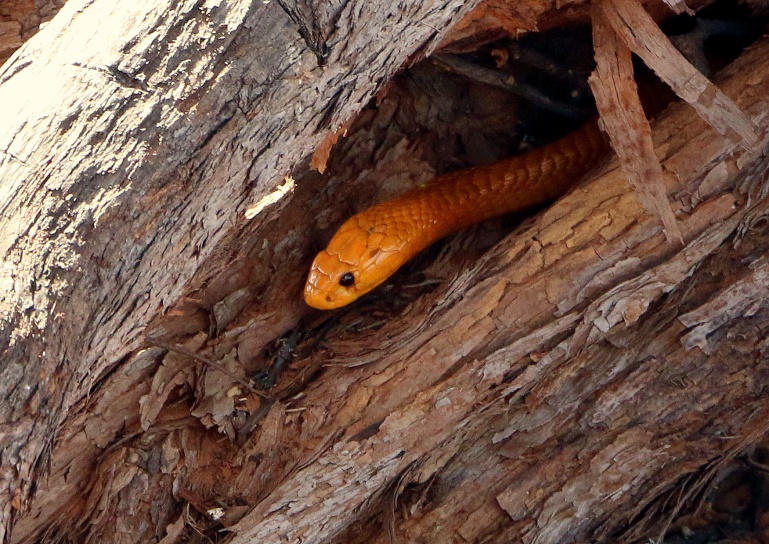
Another time, we'd barely finished pitching our tent under a large camelthorn tree when a large Cape cobra came flying from its hiding place, passed between our legs at speed, and disappeared into the tree. This tree was only a metre and a half from our setup.
For the next three days, the cobra made regular appearances in the branches — at which point the starlings went berserk and dive-bombed it — and at the base of the tree, at which point every living creature in the area chased it back up. I stood there like a bush-veld Doctor Doolittle: rake in hand, pheasants to my left, ground squirrels to my right, starlings strafing overhead, everyone contributing their own sound effects. It left on the night of day three.
You could tell it left in a hurry — its tracks showed it barely touched the ground, about a metre between each contact point. I can't say I blamed it.
We have also, on two separate occasions, been sitting comfortably in our camp chairs with cold drinks when someone quietly announced: "Snake." You sit completely still and watch it slide underneath your chair on its way to wherever it was going.
Snakes only strike when threatened. The trick is to not threaten them. This is easier to remember in theory than in practice.
Baboons and Monkeys: Cute Until They're Not
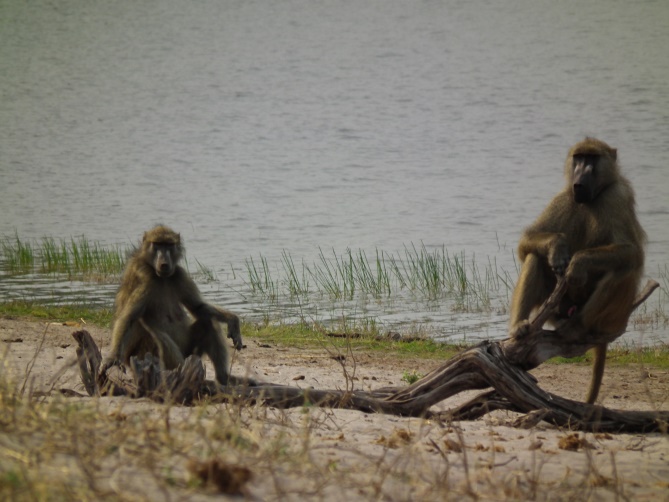
Vervets and baboons are genuinely entertaining to watch in the wild — social, clever, full of drama. We have spent many happy hours observing their antics from a respectful distance. The key words there being respectful distance.Around Cape Point, baboons will brazenly approach people and steal food and drinks without a flicker of remorse. They have sharp teeth and they know exactly what they're doing. Close your car. Close your tent. Hide your food. A baboon who has decided he wants your lunch is not open to negotiation.
Vervet monkeys are delightful and charming right up until they're eyeing your provisions — at which point they rapidly become those monkeys, followed by language that I won't reproduce here. At one camp, a monkey stole our bread and a piece of meat. We gave chase. We did not get it back. Throwing rocks also didn't help — though I'll admit it provided some emotional release, moderated by the fact that I am not a good rock thrower. Curiously, underneath the bush where this particular monkey sat eating our lunch, there was quite a pile of throwing-sized rocks and pieces of braai wood already accumulated. He had clearly been doing this for a while.
We were not his first victims. If a monkey gets into your tent or car, do not frighten it. A calm, gentle approach is strongly recommended — otherwise you'll be cleaning the interior in ways that require both equipment and therapy.
Do not pitch your tent under large trees. We learned this twice, which means we are moderately slow learners. Baboons and monkeys use large trees as their overnight accommodation, and they are not considerate guests. Waking up to the sound of plop, plop, plop on your tent — or the gentle sound of liquid rain that is not rain — is an experience that recalibrates your morning outlook considerably.
In the Moremi, we also watched with great amusement as monkeys used the neighbouring tents as slides and trampolines. Less amusing when it was our tent. You chase them off; they come straight back the moment you turn around.
Lions in Camp: The Ones You Never Forget
On our very first Botswana trip — three weeks of it — we saw precisely one lion, briefly, next to a road. We spent the rest of the time being woken by korhaans and visited by jackals. Since then, the lions have more than made up for it. My wife and I used to wonder how we'd actually react if we came face to face with a lion in camp. At Mapayutlwa, we got our answer. We'd heard lions roaring through the night — maybe 200 to 300 metres north of us. The next morning, over coffee, we broke camp in turns, one of us always standing guard. A hyena crossed the pan. Then a lioness. Then my wife said the word: "LION." I was beside her in an instant. The sun was just cresting the horizon, painting the pan grass yellow. A huge dark-maned lion was strolling along the edge of our campsite, eyes fixed on the lioness in the pan. He stopped. His mane glowed golden in the sunrise. He looked at us for a second or two. Then he walked away and roared — and you could see it in the cold morning air, and feel it in your chest. Every hair on my body stood up. I was not scared — not in that moment. Afterwards, when the hindsight arrived, yes: he would certainly have won any race to the car. There may well have been another one behind us. But in that moment? Pure, undiluted awe.
Then there was the morning I stepped out of our trailer tent intending to use the toilet, and my wife calmly informed me there were lions approaching. I retreated back into the tent at speed and immediately forgot why I'd wanted to go outside. Then remembered the camera was in the car. So I stepped back out, grabbed the camera, and got back up onto the top of the trailer — which is a more athletic manoeuvre than it sounds.
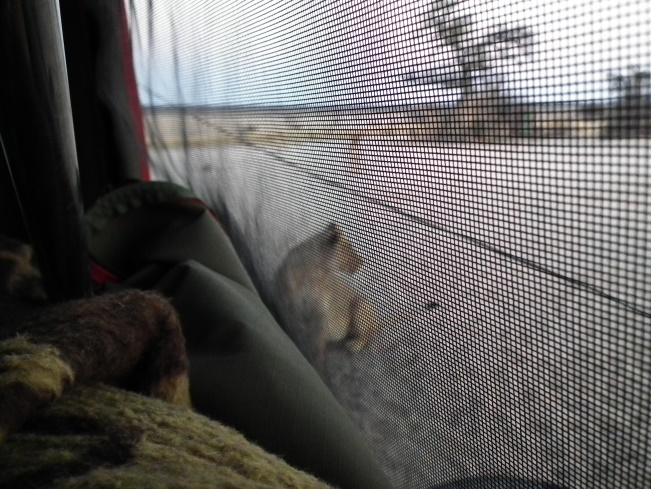
Three lionesses and one very battered old male came towards us. Two ladies lay down gracefully close to the tent. The third investigated us more closely — drank from a bucket I'd used to wash my feet, which stupidly left outside the previous night, then pushed her nose deep into the mesh of the tent door, looking directly at us from centimetres away. We lay very still on top of the trailer as we looked into those yellow eyes with only a layer of netting between us and them. Very humbling...
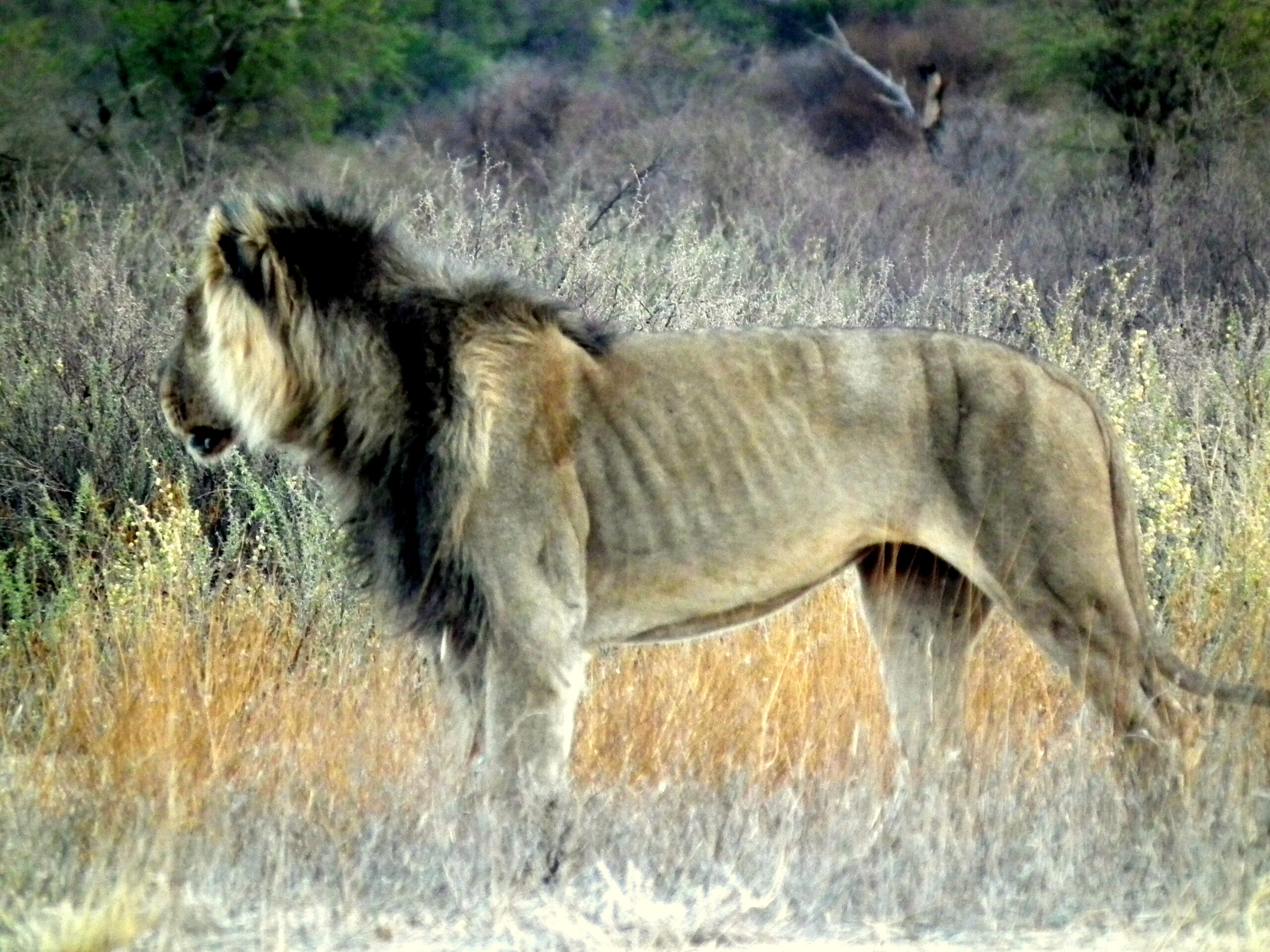
That male, when he finally followed the ladies away, was something to behold — thin, scarred from a lifetime of battles, porcupine quills embedded in his neck, chest and legs, walking with a limp. Magnificent and heartbreaking in equal measure. We suspected he was trailing the ladies in the hope of sharing whatever they caught. Solidarity, old boy.
On another cold August morning — cold enough that lifting your head off the pillow left it feeling like an ice block — we were packing up when my wife spotted a lioness wandering casually into our camp. She walked between our tent and our friends' tent, found her exit route blocked, turned around, and walked back past our friends who were sitting with their morning coffee with nothing but a camping table between them and her. She paused opposite the table. Appeared to assess the menu. Decided they were not what she was looking for. And walked out of camp. The convoy was on the road to the waterhole within minutes.
Elephants: Large, Opinionated, and Always Right
Elephants are generally peaceful unless: the bulls are in musth, you're somewhere they want to be, or — worst of all — you have inadvertently placed yourself between a mother and her calf. That last one puts you in trouble. Big trouble, in every sense of the word. The aunts and sisters will join in. Size is not on your side. Give them space. They may not return the favour.
At Nambwa Island in the Zambezi region, elephants grazed the island from north to south through the night — breaking branches, chewing methodically, and flatulating with magnificent frequency. They moved closer and closer in the dark, their grey shapes growing larger with each step until they were brushing past our tent. One had what appeared to be an itch in an awkward location and used the tree immediately next to our tent to address it. We sat in complete silence. They showed no distress, no aggression. They simply grazed past us, moonlight shimmering on their backs, and eventually wandered back the way they came. Extraordinary.
In the Moremi, the enormous sausage trees produce pods of similarly impressive dimensions. If one falls on you from height, you will know about it. If one falls on your car, your car will know about it. Elephants love these pods intensely and have been known to move vehicles parked beneath the trees to get to them. Your car, in this situation, is simply an inconvenience to be relocated.
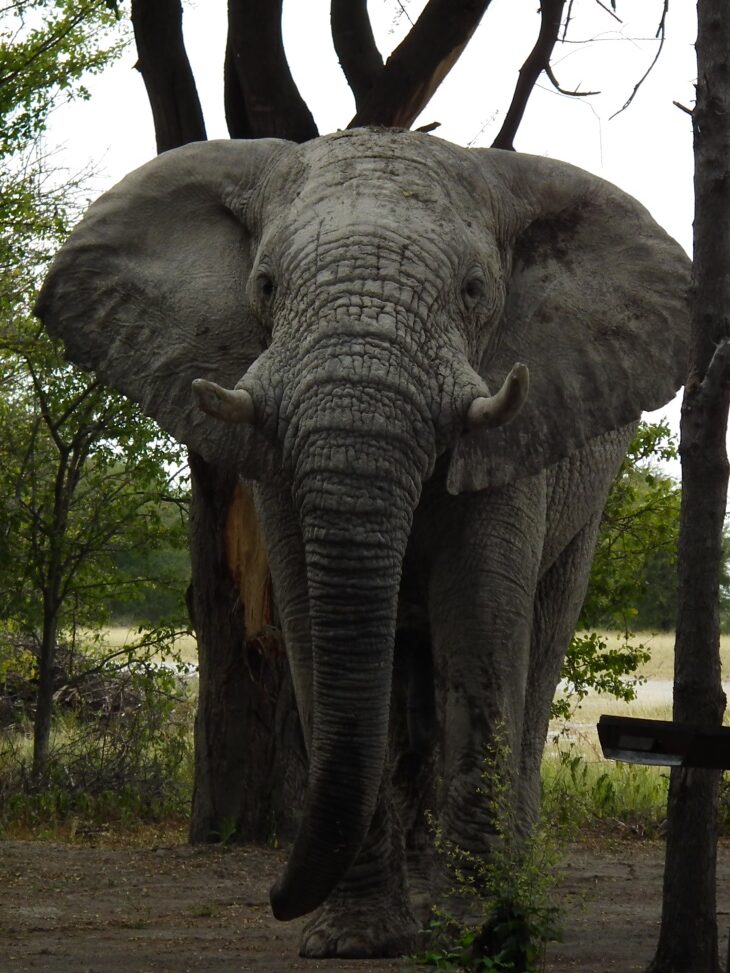
At Senyati, on the Botswana-Zimbabwe border, we stopped to photograph an elephant grazing in camp. This particular elephant had views about being photographed. Without so much as a warning head-shake, it spun around and charged. We split immediately — my wife went one way at ninety degrees, I went the other. The elephant stopped between us, apparently unsure which problem to address first. It turned around, and ambled back to its grass. We regrouped without speaking for a moment.
Jackals, Civets, Mongooses and One Very Surprising Cat
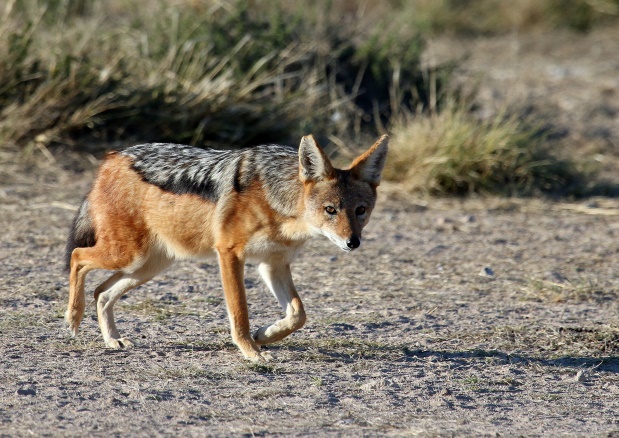
The black-backed jackal is sly, clever, charming, and completely amoral. They'll lie a few metres from your fire with infinite patience, waiting for the moment you step away from your braai. They test their luck with lions, so you were never going to be much of a deterrent.
There's a story from one of the camps we know — a jackal kept inserting himself into a group of tourists each evening, clearly seeking protection. On their last night, a leopard rushed in and snatched the jackal from inside the camp. Sir David Attenborough, apparently, would not have been surprised: canines are high on the leopard's list of preferred menu items.
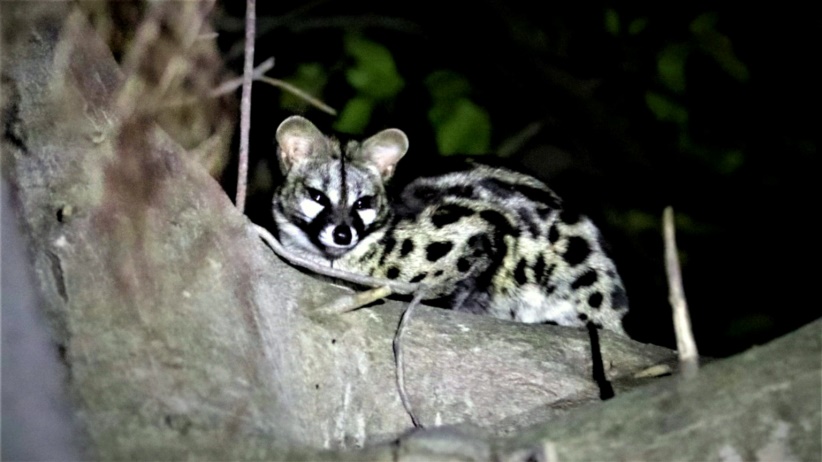
Civets look elegant and are completely dishonest. In the Cederberg, we watched these beautiful creatures lounging decoratively around our campsite — and only realised too late that they were casing the joint. They took a sandwich. Then a piece of meat. Then, in the night, they somehow got into the tent, stole a leftover sausage, and couldn't find their way back out — leading to a memorable performance involving pots and pans at 2am. When we broke camp the next morning, I noticed a peculiar smell — stale Nik Naks, unmistakably. We hadn't brought any. Eventually we found where a civet had marked our tent as its personal territory. It smelled exactly like stale cheese curlers.
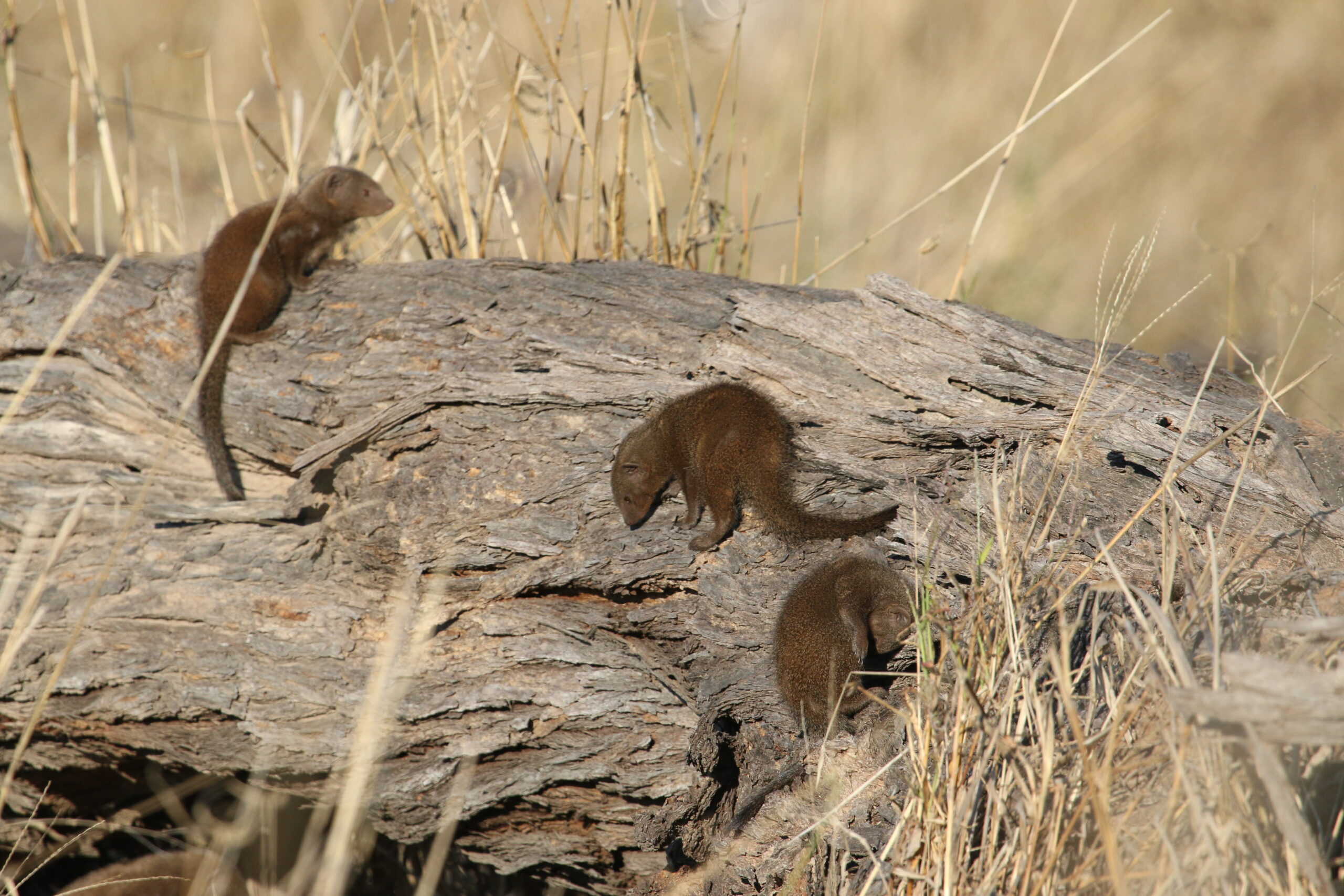
In Savuti, dwarf mongooses visited our tent with enormous puppy-dog energy — front paws on the entrance, huge eyes deployed at maximum effectiveness. Resistance was impossible. In they came, sniffing at everything. Some of the smaller ones couldn't figure out how to get back out and had to be gently assisted. Extremely cute. Zero dignity.
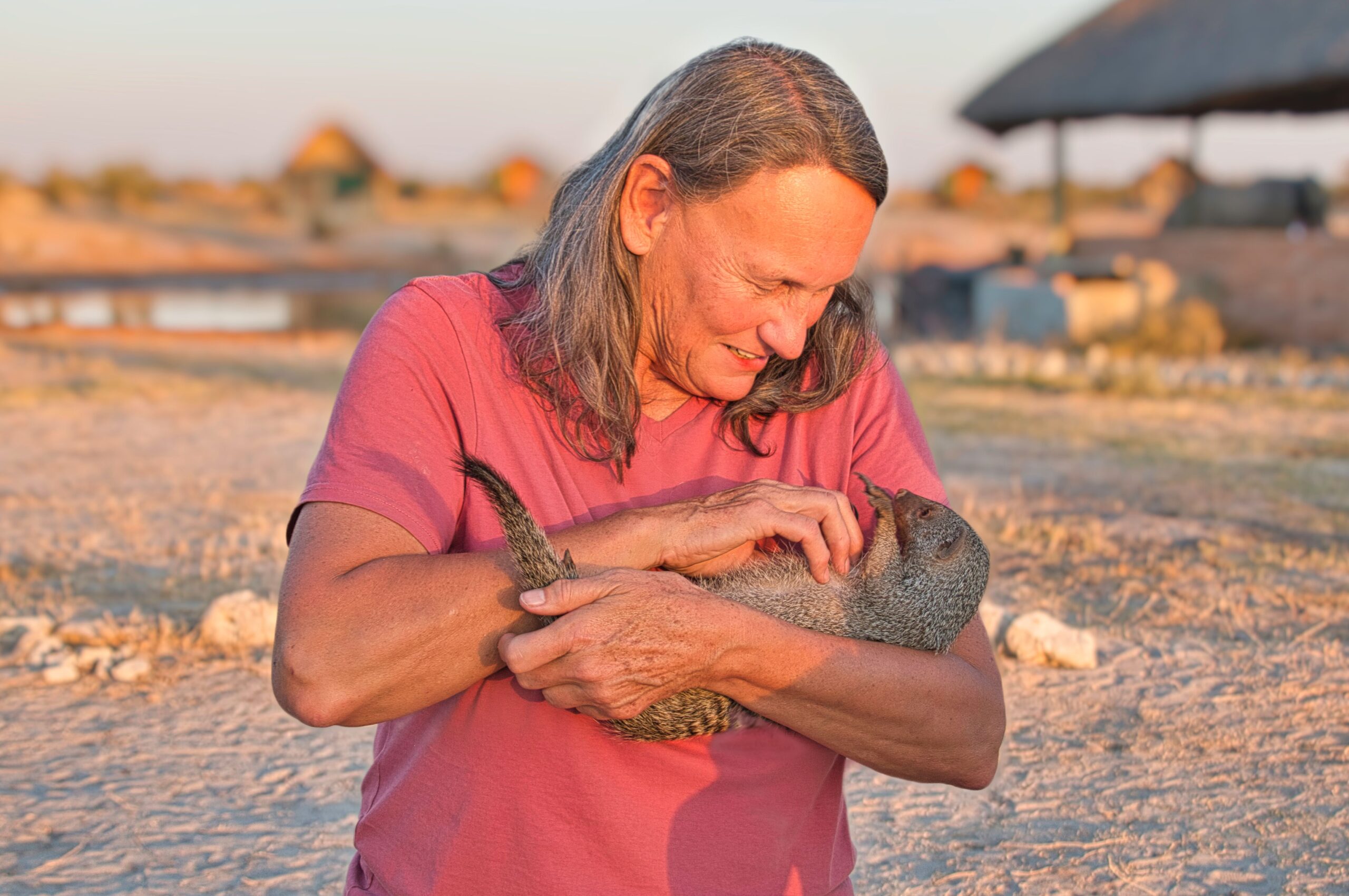
At Elephant Sands, we were visited by a banded mongoose attempting to infiltrate our fridge — alone, which was unusual, since they travel in packs. This one, it turned out, was hand-raised. The owner's wife arrived carrying another one and explained: they'd been found abandoned, severely dehydrated and hungry, and the family had nursed them back to health. Now they foraged freely but loved chicken. My wife picked one up and scratched its belly. The mongoose had opinions about this and all of them were positive.
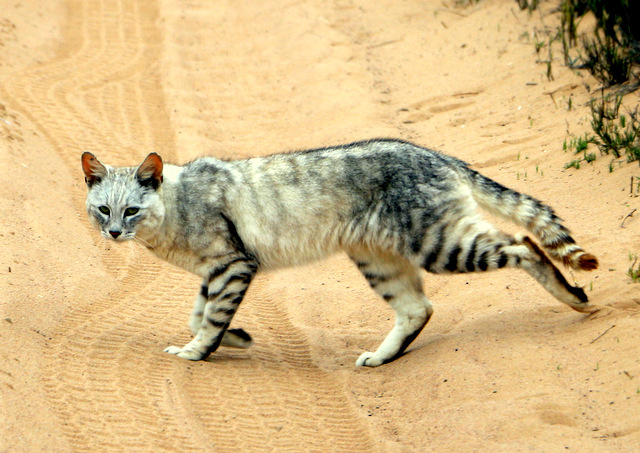
Then there was the cat. We were camping on a farm in the Cederberg with friends. Farm cats wandered about in the normal manner, except for one — slightly different, somehow. Wrong shape. Wrong energy. We couldn't identify the breed. At sunset, this cat climbed into our vehicle. We were on a remote farm with no towns nearby and this cat was growling at us in a register that no domestic cat has any business producing. We collectively decided to leave it alone and see what developed. Gradually it warmed to us. It didn't purr — it idled, loudly, like a small engine. When it meowed, it sounded like the opening scene of a horror film.
When we went to bed, it climbed in with us and slept until early morning, then left and was never seen again. The farmer's wife later told us it was an African wildcat — normally resident with them, but habitually seeking alternative lodging whenever guests arrived. We had shared our bed with a wildcat and hadn't known it. Africa.
Birds: Charming in Small Numbers
When a few birds share your campsite, you feel at one with nature. When thousands of them descend, the feeling becomes somewhat different.
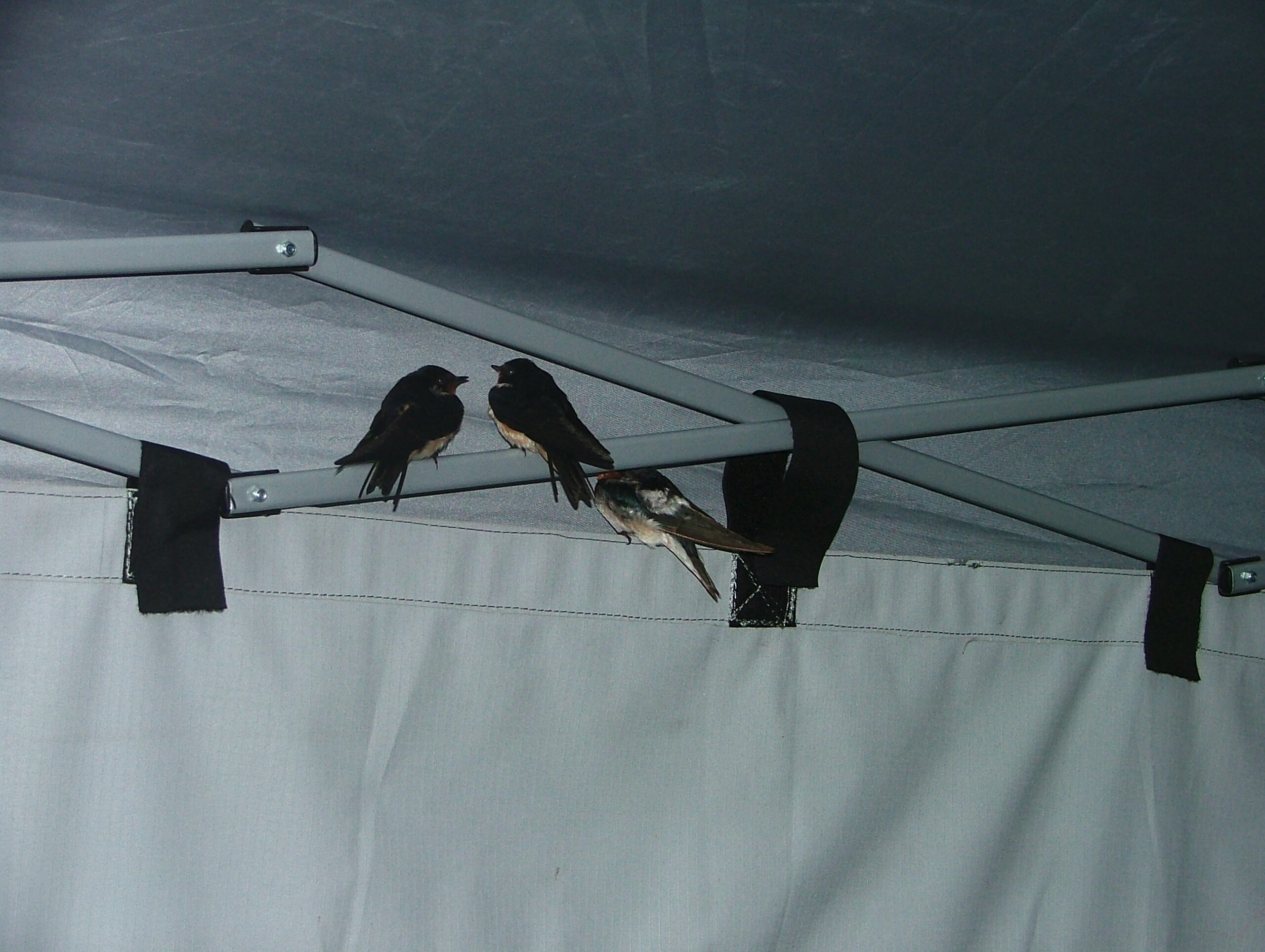
We arrived at Deception Pan in early March to find hundreds of exhausted European swallows everywhere — so tired that some didn't even move when you stepped near them. The jackals had clearly lost all interest; there were simply too many. That evening, swarms settled on top of our tent between the inner and fly sheet. My friend's tent had none, so he sportingly moved a cluster onto his own tent. We felt noble and conservationist. The following morning, the swallows departed, and both tents looked like guano art installations. You're welcome, swallows
In the Overberg, a pair of spur fowl joined us for morning coffee and rusks. When we didn't produce crumbs fast enough, one flew onto my shoulder and the other onto my hat. The one on the hat was acceptable. The one on my shoulder had very sharp ideas about breakfast.
At Lesholoago, a flock of guinea fowl settled in a tree two hundred metres away for the night. At some dark predawn hour, there was an almighty commotion followed by what sounded like feathered chaos crashing through the trees around our trailer. At sunrise, we found a leopard sitting nearby. It had apparently tried for an early snack but the fast food was, on this occasion, too fast. I spent some time afterwards contemplating what it would have been like to be woken at 3am by a leopard in the tree above us, a screaming bird in its mouth, approximately one metre from my ear. I'm glad I didn't have to find out.
Guinea fowl in general deserve a note. They routinely run ahead of your vehicle at speed, as though performing important traffic management functions, refusing to get out of the way despite having wings and an obvious alternative. You stop; they stop. You start; they run. It goes on for a startlingly long time before they remember they can simply go sideways. A flock of guinea fowl is officially called a confusion. This seems exactly right.
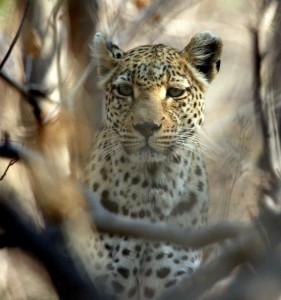
Leopards are extraordinarily elusive, and seeing one triggers a very specific kind of chaos inside any vehicle — pointing, shouting, elbows, cameras, someone's finger in someone else's eye. And then they're gone.
One night at Mapayutlwa, we heard three leopards calling simultaneously — one across the pan, one in the pan, and one that emerged from behind our camp. That sound — the rasping, sawing call of a leopard at close range — reaches something very old and deep inside you. Primordial is the only word for it. It lasted what felt like an hour.
The previous evening, I'd spent considerable time trying to photograph the rising moon — adjusting settings, fiddling, achieving nothing satisfactory, eventually giving up to make fire and dinner.
The following morning we found a leopard — a spectacular one, posing beautifully, offering every angle. As per usual, one sees a leopard, again frantic gestures, shouting and reaching for the camera.
The camera, of course, was still set for moon photography. The resulting images were almost entirely white, with some spots. We have since taken excellent leopard photographs. Lesson thoroughly learned.
Hyenas: Misunderstood and Magnificent
I am, and have always been, a hyena enthusiast. I know this is unusual.They are strange animals — not quite dog, not quite cat, not quite either — and they are very badly misunderstood. People call them ugly, cowardly, and evil. What they actually are is highly intelligent, socially complex, enormously successful hunters, and deeply curious. Cautious around people, yes — but curious
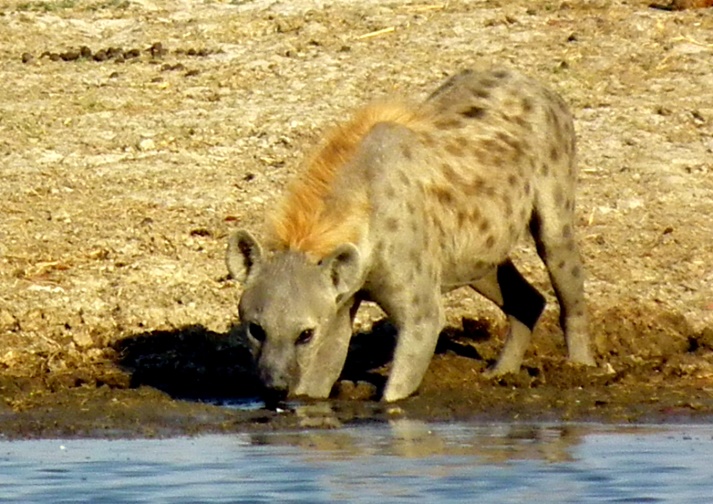
Our first encounter at Moghoto campsite: we swept a flashlight around the camp and 28 eyes reflected back at us. Twenty-eight. The entire perimeter was hyenas — standing, sitting, lying, patiently waiting for us to go to sleep. They were active all night. The next morning, hyena tracks were printed across every centimetre of camp. It was, in retrospect, a very good thing we had packed everything away.
One night I sat alone outside in the dark waiting for them. There was enough moonlight to see clearly as they approached the tent. They are, I should tell you, considerably larger up close than you expect. These are animals that fight lions for food. I thought about this, decided the tent was probably sufficient barrier, and went back inside. They came back almost immediately, sniffed around, found nothing interesting, and moved on to the next campsite. When a spotted hyena whoops close to your tent, it is loud. The kind of loud that bypasses your ears and lands directly in your chest.
At Third Bridge, we walked back from the ablution block one evening — flashlights on, alert as always — and as we entered our campsite, a spotted hyena walked straight past me, through the camp. We shouted some choice Afrikaans words at it. It appeared to understand both the sentiment and the urgency, and left at speed.
On another trip, a young hyena sauntered into the camp and sniffed out the frozen meat on the table. The missus will have none of that and flicked at it with a dishcloth, shouting, go away, we have nothing for you.
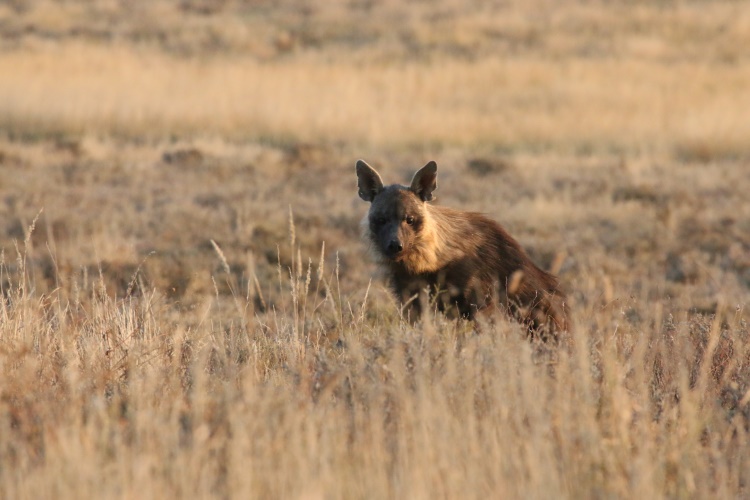
Brown hyenas are solitary and mostly nocturnal, though we've seen them in daylight too. One stole a drying cloth from our washing line at Kgalagadi. At Lesholoago, I found one coming toward me on the road while I was trying to photograph the sunset. I asked it to stand still and pose. It did — backlit by the setting sun, looking over a bush, genuinely beautiful.
Meanwhile, my wife — gin and tonic in hand, enjoying her own sunset moment around a tree — heard quiet footsteps approaching and found a second brown hyena coming her way. This one was in magnificent condition: dark brown coat shot through with gold, the prime specimen to my rather more dishevelled one. Realising I hadn't noticed her hyena, she called out: "Peter, I want my hair coloured like this one!"
I turned. Mr Prime saw Mr Shaggy. What followed can only be described as a territorial dispute that disappeared off into the sunset at considerable speed, taking both hyenas with it and leaving us standing in the road with our cameras and an excellent story.
I have seen a striped hyena exactly once in my life — it bolted from its lair on top of Streephoogte Pass in Namibia and frightened everyone present out of several years of life.
The encounters were plentiful. We cannot wait to have more.
Happy travelling. — Peter Rau